.jpg)
How Do I Do a Trademark Search Before Filing? (Step-by-Step Guide)

Cue the disclaimer music: I'm an attorney, but reading this doesn't make me your attorney — no attorney-client relationship forms here. Search strategy and risk assessment are exactly the kind of fact-specific judgment calls where general information runs out of road. Helpful guideline, yes; legal advice, no. For your actual name and your actual filing, talk to a lawyer.

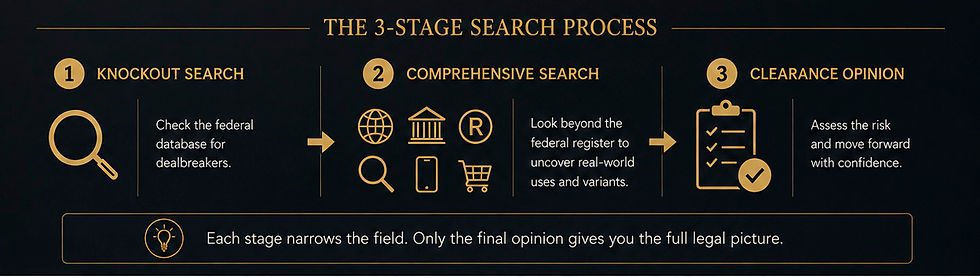
Here's the honest answer up front: a trademark search generally runs in three escalating stages. (1) The knockout search which is a fast pass through the USPTO's federal database for exact and near-exact matches, to rule out the obvious issues before you spend a dime. (2) The comprehensive clearance search that is the real diligence: the federal register including pending applications, the trademark registers of all 50 states, and unregistered "common-law" uses found through search engines, social platforms, app stores, domain registrations, business directories, and trade press — hunting not just for your name, but for marks that sound like it, look like it, or mean the same thing in another language. (3) The clearance opinion is a judgment call about whether anything you found actually blocks you.
Stage one you can do yourself in an afternoon. Stage two you can attempt, though it's the stage where DIY searches quietly fall apart. Stage three is where a trademark attorney earns their fee, because the legal test isn't "is my exact name taken?" It's likelihood of confusion: would customers plausibly mix your mark up with an existing one for related goods or services?
That distinction is why "I searched and it was available" is the most expensive sentence in trademark law. Let's do it properly.
Why Isn't an Exact-Match Search Enough?
Because the USPTO doesn't examine your application by looking for identical names. Examining attorneys refuse applications over marks that are confusingly similar, which sweeps in:
Sound-alikes: KWIK and QUICK, LYFT-style creative spellings, phonetic twins
Look-alikes: marks with the same dominant word, plus or minus descriptive extras
Mean-the-same: even translations, the USPTO applies a doctrine that compares foreign words by their English meaning, so "LUPO" can conflict with "WOLF"
Related goods: your coffee brand vs. an existing café; your app vs. an existing tech service. Confusion doesn't require identical products, just a plausible overlap in customers' minds
An exact-match search catches none of that. It's the trademark equivalent of checking for oncoming traffic by looking only straight ahead.
Knockout Search vs. Comprehensive Search: What's the Difference?
These are two different products, and mixing them up is how people end up believing they have cleared a name they haven't.
A knockout search is triage. You run the exact name and a few obvious variants through the USPTO's federal database looking for a dealbreaker. It's fast, it's cheap, and its only job is to save you from spending money on a name that's likely dead on arrival. What it can't tell you is that you're clear. A clean knockout result generally means "no obvious problem," not "no problem." That's a limitation, not an indictment. A knockout is the right first move on nearly every project. It just isn't the last one.
A comprehensive clearance search is the real diligence. It reaches:
The federal register, including pending applications — a filing from last month can block you just as thoroughly as a registration from 1994
The state trademark registers generally maintained by the 50 secretaries of state
Common-law uses for businesses using a name without ever registering anything, anywhere
Domains, app stores, marketplaces, social handles, trade press and directories
Variants: phonetic equivalents, alternate spellings, foreign-language equivalents, and, for logos, visually similar design marks

Comprehensive searches are usually run as a professional report, then interpreted by an attorney. The report is the raw material; the opinion is the deliverable. And there is ground between the two, which is where a lot of real projects land. More on that below.
Do State Trademark Registrations Actually Matter?
Yes. But not in the way most people assume, so here's the nuance.
A state trademark registration generally will not be cited against you by a USPTO examining attorney. Federal refusals for likelihood of confusion rest on federal registrations and prior-filed federal applications. So on the narrow question of whether your application gets refused, state registrations sit outside the examiner's field of view.
That does not make them harmless. A state registration is a flare signaling a prior user with common-law rights in that territory. Those rights that can support an opposition to your application, a petition to cancel your registration later, or a geographic carve-out that permanently fences part of the country off from your brand. Finding that user during a search is cheap. Finding them after you've printed signage is not.
The same logic applies to unregistered users who never filed anything at all. Rights in the U.S. generally flow from use, not paperwork.
Step-by-Step: How to Do a Trademark Search
The full sequence, from the trademark attorneys at Markley:
Start with a knockout pass on the USPTO's trademark search system. Search your exact name first but treat that as the warm-up. Then search fragments, phonetic variations, alternative spellings, and the dominant word alone. Include pending applications, not just registrations. A filing from last month can block you just as thoroughly.
Search within related classes then ignore class lines. Focus on the classes covering your goods and services, but remember confusion crosses class boundaries when products are related (beer and restaurants, software and tech services). Class lines organize the USPTO's paperwork; they don't draw the boundaries of confusion.
Use the image search for logos. The USPTO's AI-powered image search lets you upload your logo and surfaces visually similar registered marks — reverse-image-search style. This used to require navigating an arcane design-code system; now it's genuinely accessible. If you're filing a design mark, use it.
Check the state registers — both entity and trademarks. Two different databases get confused constantly. Secretary of state entity filings (LLC and corporation names) tell you who is incorporated under a similar name; they create no trademark rights by themselves. State trademark registers are separate filings that signal an actual brand user claiming rights in that state. Search both. Neither gets cited by a federal examiner; both can surface someone with prior common-law rights.
Go hunting for common-law uses. Search engines, Instagram and TikTok handles, app stores, domain registries, Amazon and Etsy listings, trade publications, industry directories. Unregistered users have rights too. The business that never filed anything can still oppose your application or carve territory out of your registration.
Check the "graveyard" too. Dead and abandoned applications in the USPTO database are intel: a mark refused five years ago for descriptiveness tells you something about your own odds with similar wording.
Assess what you found — honestly. For each hit, ask: how similar is the mark (sight, sound, meaning)? How related are the goods or services? Would we share customers or channels? This is the likelihood-of-confusion analysis, and it's a legal judgment, not a database result. Similar name + related goods = real risk, even if nothing is identical.
What Do I Do With the Results?
Three buckets:
Clear: nothing similar in related fields. File with confidence and file soon, because clearance results have a shelf life. Someone can file tomorrow.
Cluttered: similar marks exist, but arguably in unrelated fields or with distinguishable elements. This is judgment-call territory. The difference between "coexists fine" and "office action incoming" often turns on details like trade channels and customer sophistication. This is generally attorney territory and you should probably seek guidance.
Blocked: a similar mark on related goods, alive and in use. The cheapest moment of your branding life is right now, before you've printed anything. Pivot the name. (An attorney can sometimes see paths a layperson can't such as consent agreements, narrowed descriptions, arguments from crowded fields, but sometimes the right advice is genuinely "pick a new name," and you want an advisor willing to say it.)
Which Level of Search Do I Actually Need?
Search depth is a dial, not a switch. There are three practical levels, and the right one depends on what you're risking.
Knockout. A fast federal pass for exact and near-exact matches. It can rule a name out; it can never rule one in. A reasonable starting point when the name is coined and distinctive, the category is quiet, and walking away from the name wouldn't cost you much.
Spot check. A targeted search that goes deeper than exact matches on the specific risks your mark actually has: the dominant word, the obvious phonetic and spelling variants, and the two or three classes where your real competitors live. The middle ground when the name is suggestive rather than invented, the field is crowded, or you're about to put the name on packaging and signage.
Full clearance. Comprehensive coverage across the federal register, the state registers, and common-law uses, read by an attorney who gives you an opinion on the risk. The right call when the name is going into funding documents, a franchise system, retail placement, or anything you can't afford to abandon in eighteen months.

Here's the part nobody selling search likes to say plainly: a deeper search doesn't guarantee a registration, and a knockout isn't worthless. What matters is that you know which level you bought and what it can and can't tell you. Any search should come with that disclosure. If it doesn't, ask for it.
Markley prices search at all three levels for exactly this reason. Not every brand needs full clearance, and paying for it isn't always the best use of a launch budget. What we won't do is run one level and describe it as another.
What Does a Professional Search Add?
Fair question, since the federal database is free to search.
The honest answer is that free search and clearance are different things, and the gap between them is where the money goes. Plenty of budget filing services run a knockout, call it a clearance search, and file. The problem there isn't the knockout. A knockout is a legitimate tool and often the right first step. The problem is presenting stage one as though it were stage three, so the client believes a name was cleared when it was only screened.
What the professional version adds is the other two stages: comprehensive coverage (state registers, common-law uses, and the phonetic, foreign-language and design variations that ad-hoc searching misses), the confusion analysis (a legal opinion applying actual refusal standards, not a gut feeling), and accountability (a documented basis for the filing decision).
Remember the stakes: USPTO fees are non-refundable, and a refusal costs months even when it costs nothing else. The clearance opinion is also the part that is legally the practice of law. It's advice about your rights, not a database export. At Markley, that opinion comes with our full clearance work, and every engagement tells you up front which level of search you're getting. If what we find says your name has issues, you hear it before you file, not after.
FAQ
What's the difference between a knockout search and a comprehensive search?
A knockout search is a quick federal-database check for exact and near-exact matches. It can rule a name out, but it can't rule one in. A comprehensive clearance search adds the state trademark registers, unregistered common-law users, domains and marketplaces, and phonetic, foreign-language, and design variants and it's read by an attorney who gives an opinion on the risk.
Do state trademark registrations block my federal application?
Generally no. Federal examiners refuse applications based on federal registrations and prior-filed federal applications. But a state registration flags a prior user with common-law rights who may be able to oppose your application, seek cancellation, or claim a territory. Worth finding early.
Is there a free official trademark search?
Yes. The USPTO's trademark search system is free and public, including image search for logos. Free access to the database isn't the hard part; the analysis is.
Someone has my name but their trademark is "dead." Am I clear?
Maybe. A dead registration doesn't block you at the USPTO, but if that business still uses the name in commerce, they retain common-law rights that can bite later. Check whether the business is alive, not just the filing.
Do I need to search internationally?
If you sell only in the U.S., a U.S. clearance is the priority. Expanding abroad? Each country is its own rights system. Search before you enter, ideally before you commit to global branding.
How long does a professional search take?
Typically days, not weeks. Trivial compared to the months a refusal costs.
The name is clear but the .com is taken. Does that matter?
Legally, a parked domain alone creates no trademark rights against you. Practically, investigate who owns it and why — an active business behind that domain is a common-law user you need to evaluate.
Every trademark disaster story starts the same way: "we didn't really search." Markley searches at three levels, from a knockout screen through a targeted spot check to full clearance, and we'll tell you which one your name actually calls for before you spend a filing dollar. Search first. Then own your mark.