.jpg)
Dupes vs. Counterfeits: What's Actually Illegal?

Housekeeping before the fun part: I'm an attorney, but I'm not your attorney, and reading this creates no attorney-client relationship. This area of law is genuinely unsettled and intensely fact-specific. The whole post is about how blurry the lines are so please treat it as general information rather than legal advice. For your product and your situation, talk to a lawyer.
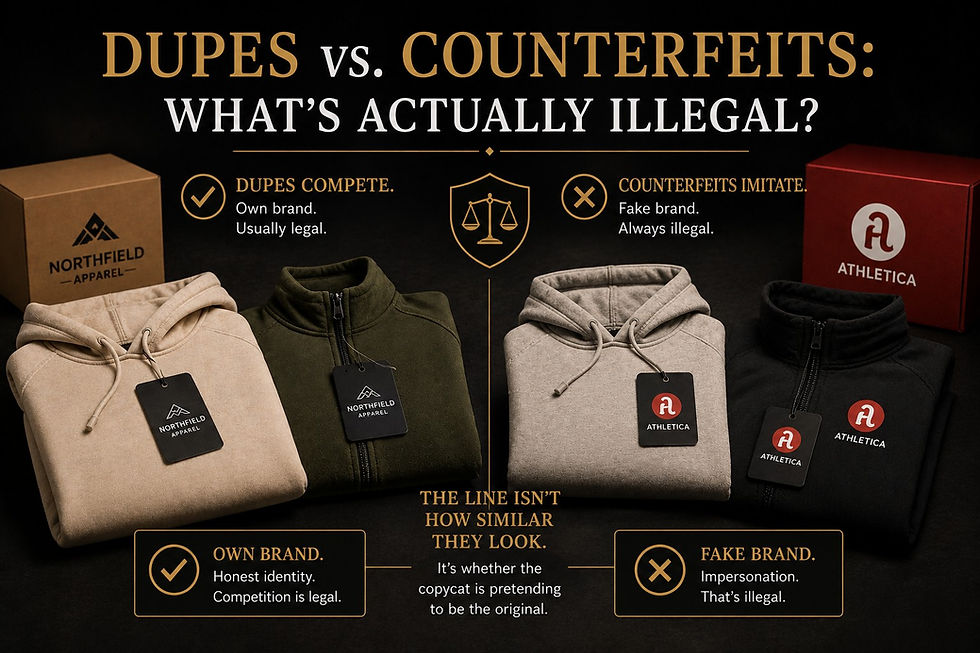
Here's the clean version: a counterfeit is a fake that carries someone else's brand name or logo. That's illegal, full stop. A dupe is a product that imitates the look and feel of a popular item while wearing its own honest branding and that's often legal.
The line between them isn't how similar the products look. It's whether the copycat is pretending to be the original brand. Selling a fake Lululemon hoodie with a Lululemon logo on it is counterfeiting. Selling a very similar hoodie under your own name, at a third of the price, is usually just competition, the thing capitalism is supposed to do.
Between those two poles sits an enormous gray zone, and it's where nearly every real fight happens. That zone has a legal name: trade dress. Here's how it works, why one of the biggest dupe cases in the country ended without answering the question, and what a small brand can actually do about knockoffs.
What Makes Something a Counterfeit?
A counterfeit uses a mark that is identical or substantially indistinguishable from a registered trademark, on the same goods. That's the whole test, and it's why counterfeiting is the easy case.
The fake handbag with the real logo. The knockoff sneaker with the swoosh. The phone charger in packaging cloned from the original. Consumers can't tell, and that's the point. The seller is harvesting a brand's reputation by impersonation.
Counterfeiting carries the heaviest consequences in trademark law: enhanced damages, seizure of goods, customs interception, and in serious cases, criminal liability. Platforms remove counterfeit listings faster than any other category, because verification is straightforward. Either the seller is authorized to use that mark or they aren't.
So What Exactly Is a "Dupe"?
A dupe (short for duplicate) mimics a more expensive product's look, feel, formula, or function without copying the brand name. The $8 hoodie that looks like the $118 one. The drugstore serum in packaging that echoes the luxury one. The dupe seller isn't hiding: the whole appeal, broadcast through viral hashtags and influencer hauls, is this looks like that, for less.
And here's the uncomfortable truth for brand owners: imitation of an unprotected design is generally legal. Trademark law protects source identifiers, not attractiveness. Patents protect inventions, and they expire. Copyright protects creative expression, and clothing designs largely fall outside it. If nobody owns the look, everyone may copy it.
Which is why dupe fights turn on one question: did the original brand own the look?
What Is Trade Dress, and Why Does Everything Hinge On It?
Trade dress is the legal term for a product's overall visual identity — its shape, packaging, color scheme, layout, the whole gestalt — when that appearance functions as a brand. The classic examples are the contoured Coca-Cola bottle and the distinctive layout of a restaurant chain.
Trade dress can be protected, but the bar is high. Generally you must show:
Non-functionality. The feature can't be there because it works better. If a design element makes the product perform, competitors get to use it otherwise trademark law would become a patent that never expires.
Distinctiveness. For product design specifically, you generally must prove secondary meaning such that consumers have come to associate that look with one source. Not "it's pretty," but "shoppers see this shape and think of us."
Likelihood of confusion. Consumers would plausibly believe the two products come from the same company or are somehow connected.
That third element is where dupe culture creates a genuine paradox. When shoppers proudly post about buying a dupe, they're announcing they know exactly whose product it isn't. That undercuts confusion. But the same viral attention can help prove element two. If the internet universally recognizes the look as yours, that's powerful secondary-meaning evidence.
Brands are stuck arguing both sides of the same phenomenon.
What Happened in one of the Biggest Dupe Cases?
In June 2025, Lululemon sued Costco in federal court in California over private-label apparel it said copied its bestselling designs — the Scuba hoodie, Define jacket, and ABC pants. The claims stacked several theories at once: trade dress infringement, infringement of the SCUBA and TIDEWATER TEAL word marks, design patent infringement, and unfair competition.
It was positioned as the case that would finally tell everyone where the dupe line sits.
It didn't. Through 2026, the parties settled the claims piece by piece. First the outerwear sold under third-party brands, then a set of pants, then a women's jacket until nearly everything was resolved, on confidential terms. No ruling, no precedent, no answer.
That outcome is the lesson, and it's worth sitting with. Dupe disputes overwhelmingly settle, which means the law stays unsettled, which means the next brand faces the same uncertainty. Litigation here is expensive, slow, and evidence-hungry. Courts want specific, well-documented trade dress claims, not vague assertions about "look and feel." For most businesses, the courtroom isn't the realistic tool.
Other cases are testing adjacent edges including disputes over packaging, color schemes, and comparative marketing language like "smells exactly like." The pattern holds: the questions are live, and answers are scarce.
What Can a Smaller Brand Actually Do?
You're not Lululemon, and you don't have a litigation budget. Here's the realistic playbook:
Register the word mark first. Your name is the strongest, cheapest, most enforceable asset you have. Dupes can copy your silhouette; the moment they use your name, you have a clean claim and a fast platform takedown.
Build the secondary-meaning file now. If you ever want trade dress protection, you'll need evidence: sales figures, advertising spend, press coverage, unsolicited social posts recognizing the look. Start the folder before you need it. It's nearly impossible to reconstruct later.
Consider a design patent for genuinely novel product shapes. Unlike trade dress, a design patent protects the unique ornamental look of a functional item from day one without needing to prove consumer recognition first. Just remember the strict deadline: in the U.S., you must file within one year of first showing or selling the product publicly, or that right is lost forever.
Use platform tools, not lawsuits. Marketplace IP programs move in days rather than years, and they're built around registration numbers. This is where enforcement actually happens for most brands.
Watch the seller's words, not just their product. A dupe that stays in its own lane is usually lawful. A dupe whose listing uses your brand name in the title, copies your photos, or implies affiliation has crossed into territory you can act on and sellers do this constantly.
Pick your battles honestly. Some imitation is the price of building something worth imitating. Spending your legal budget on an unwinnable trade dress claim is worse than spending nothing.

Am I at Risk if I Sell Dupes?
Fair question, and plenty of legitimate businesses operate in this space. General guidance:
Selling a similar product under your own distinct brand is usually lawful competition. What creates exposure is anything that borrows the other brand's identity: using their trademark in your product name or listing, copying their packaging closely enough to confuse, using their product photos, or implying a connection you don't have.
Comparative reference is a real doctrine. You can generally use a competitor's name truthfully to say what your product is comparable to. But that's a nuanced legal line, not a free pass, and it is fact-specific enough that it deserves an attorney's eyes before you build a marketing campaign on it. Keep in mind that legal and platform-friendly aren't always the same thing. While true comparative claims may be allowed under trademark law, listing algorithms on platforms like Amazon and Etsy often flag competitor brand names automatically meaning your listing can get pulled down for 'trademark misuse' long before a human lawyer ever evaluates your defense.
FAQ
Is buying a dupe illegal?
No. Trademark law targets sellers, not consumers. Buying a counterfeit isn't generally a crime for the purchaser either, though importing quantities can raise customs issues.
Can I trademark the look of my product?
Potentially, as trade dress — but you'll generally need to prove the design is non-functional and that consumers associate it specifically with you. It's a heavier lift than registering a name.
Why don't more brands sue over dupes?
Cost, uncertainty, and the confusion problem: when consumers openly know they're buying an imitation, proving they were confused gets hard. Most disputes settle quietly.
Does a dupe seller have to change their product if I send a demand letter?
Only if they're actually infringing something you own. A letter asserting rights you don't have can backfire — including exposing you to claims for improper threats.
What's the difference between a dupe and a knockoff?
Mostly marketing. "Knockoff" usually implies deception; "dupe" is the friendlier consumer-culture framing. Legally, what matters is whether the branding causes confusion, whatever anyone calls it.
Dupe culture isn't going anywhere, and the law is going to stay messy for a while. What you can control is owning your name outright — the one asset no dupe seller can borrow. Markley files federal trademarks for one flat fee, USPTO costs included, with a licensed California attorney and an honest read on your mark before you spend a dime. Own your mark.


