.jpg)
Do You Need a Trademark to Sell on Etsy or Shopify?

Updated: 3 days ago
Honest answer first: No, neither Etsy nor Shopify requires a trademark to open a shop or sell products. Unlike Amazon's Brand Registry, there's no trademark gate to get started. You can launch today, trademark-free, completely legitimately.
So why is a trademark attorney writing this? Because "required" and "wise" are different questions. You don't need a trademark to sell on Etsy or Shopify, but you do need one to stop copycats effectively. You also need to ensure you're not accidentally infringing someone else's trademark. This mistake can shut down shops. Let's take those one at a time.

Does Etsy or Shopify Require a Trademark?
No. Etsy asks you to comply with its policies and the law; Shopify hands you the keys to your own store and asks even less. There's no trademark checkbox at signup on either platform.
Compare that to Amazon, where Brand Registry, the gateway to Amazon's serious brand tools, requires a registered or pending trademark. Etsy and Shopify have no equivalent gate. Plenty of successful shops run for years without a registration.
Which means the real question isn't "am I allowed to sell without one?" It's "what am I exposed to without one?" Two things, mainly.
Exposure 1: You Can't Effectively Stop Copycats
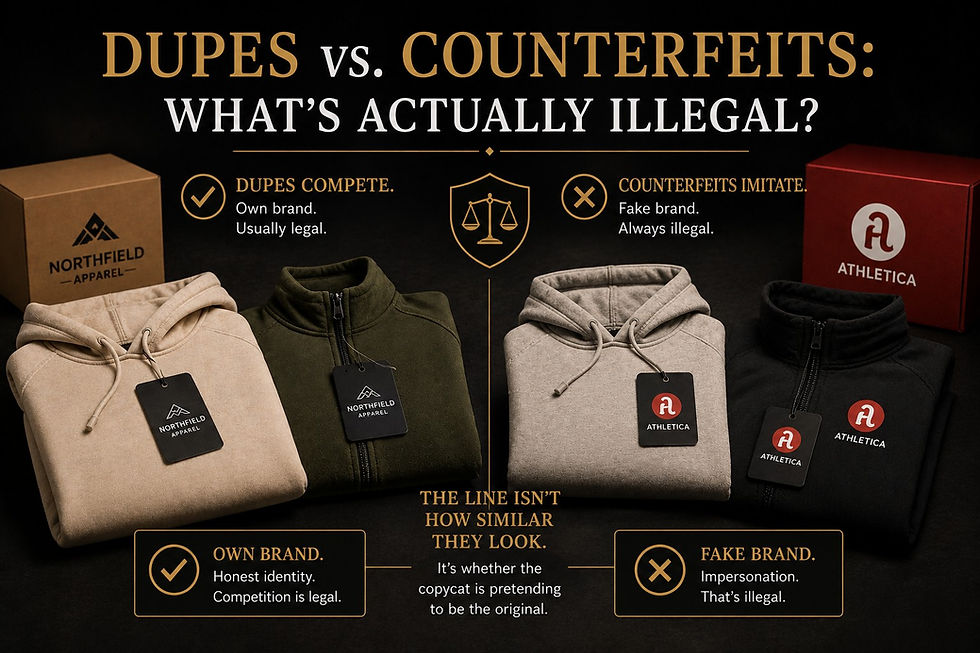
Here's the pattern many successful Etsy sellers eventually meet: your product takes off, and within weeks, near-identical listings appear. Sometimes they use your product photos, sometimes your shop name, and sometimes both.
What can you do about it?
Your photos and designs: That's copyright territory. You can file takedown notices for stolen images without any registration. However, registering copyrights helps too — different topic, different post.
Your shop name and brand: That's trademark territory. Here's where the registration question bites. Etsy's reporting system asks trademark complainants for registration details. Without a registration, you're asserting common-law rights. These are the unregistered rights that come from using a name in business. They are real but geographically limited, hard to prove, and much weaker leverage in a platform complaint. With a USPTO registration number, your report ties to a verifiable public record. Takedowns become dramatically more effective.
On Shopify, copycats usually run their own stores. Enforcement means going after them directly through cease-and-desist letters, platform complaints, or marketplace takedowns. Every one of those tools works better with a federal registration.
The blunt version: a trademark doesn't prevent copying. It determines whether you can do anything meaningful about the copying.
Exposure 2: You Might Be Infringing Someone Else's Mark
This is the risk nobody Googles until it's too late, and it's the one that actually ends shops.
If your shop name or product line is confusingly similar to someone's registered trademark, even innocently, you can receive an infringement complaint. The consequences can range from a takedown of your listings to your shop name being forced offline. In rare cases, you might even receive a demand letter seeking damages. Sellers often get tripped up by using trademarked terms in listings. Fan merchandise referencing famous brands, characters, teams, or logos is one of the most common ways handmade shops receive takedown notices.
A clearance search before you brand is essential. Check the USPTO database and the broader market for conflicting names. This step helps you avoid building a business on a name you'll be forced to abandon. It's the single highest-value step in this whole area, registration or not.
When Should an Etsy or Shopify Seller Actually File?
The honest framework:
Hold off if you're experimenting. If you're testing products, unsure of your name, or your revenue is hobby-scale, a $350-per-class filing for a brand that might pivot next quarter isn't wise spending. I’d rather tell you that now than file for the sake of filing.
File when the name has value worth defending. If you have steady sales, repeat customers, and a name people search for, that's a brand. Brands attract copycats.
File before you expand. If you're moving onto Amazon (where Brand Registry needs that trademark), into wholesale, or into retail, get the registration process started first. It takes months.
File yesterday if copycats have arrived. Active knockoffs signal that your brand is worth stealing. U.S. rights generally favor the first to use a name. Your history helps, but registration is what turns that history into enforceable, platform-recognized rights.
One quiet bonus: filing puts your name in the USPTO's public database. This deters future conflicts before they start. The best trademark fight is the one that never happens because someone searched, found you, and picked a different name.
What Would It Cost?
The USPTO's base fee is currently $350 per class of goods or services. Most Etsy and Shopify sellers fit into one or two classes. For example, jewelry is Class 14, candles are Class 4, and apparel is Class 25. Watch for the USPTO's surcharges on incomplete applications ($100/class) and custom goods descriptions ($200/class), which can inflate careless DIY filings.
Attorney help is separate. Markley bundles the clearance search, attorney-prepared filing, and the USPTO fee into one number. If the search indicates your name has risk, you’ll hear it before you pay to file.
Frequently Asked Questions
Can Etsy shut down my shop for not having a trademark?
Not for lacking one; there's no requirement. Shops get in trouble for infringing others' IP, which is a different problem.
Can I sell fan merch of famous brands or characters if I make it myself?
Making it yourself doesn't make it legal. Using others' trademarks or copyrighted characters on merchandise without a license is classic infringement. Rights holders patrol handmade platforms actively.
Does my Etsy shop name give me trademark rights?
Using the name in commerce builds limited common-law rights. However, the shop name registration itself, like a domain name, grants nothing exclusive.
Should I trademark my shop name or my product line name?
Whichever functions as the brand customers know you by, and sometimes it's both. It's a strategy question worth discussing with an attorney before you spend filing fees.
Do I need separate trademarks for Etsy and Shopify?
No. A federal registration covers your goods nationwide, regardless of platform. One registration supports enforcement everywhere.
Conclusion
You don't need a trademark to start selling. You need one when what you've built becomes worth protecting. You'll know when that is. When you do, Markley handles it for one flat fee, USPTO costs included. You’ll work with a licensed California attorney who provides a straightforward answer about whether your name will register. Own your mark.