
Should College Athletes Trademark Their Name? (NIL Brand Protection)

Quick timeout for the legal stuff: I'm an attorney, but I'm not your attorney. Reading this creates no attorney-client relationship. NIL rules vary by state, school, and conference, and they change constantly. Treat this as a starting map, not legal advice. Talk to an IP lawyer before filing anything.
If you're earning NIL money or selling merchandise, registering a federal trademark for your name, nickname, or logo is usually a smart move.
A common misconception among athletes is that state NIL rights and federal trademarks do the same thing. They don't. State NIL laws and right-of-publicity rules stop companies from using your face or likeness to market their products without a deal. A federal trademark protects your personal brand as a commercial asset—the name on the hoodie, the summer camp, or the drink line. It gives you nationwide priority, a public record of ownership, and direct leverage to take down knockoffs on Amazon, Etsy, and social media.
The USPTO has recognized this shift. Beyond publishing dedicated NIL education hubs, the agency set up an on-the-ground presence at the 2026 NFL Draft in Pittsburgh to educate incoming rookies on brand protection. When the federal trademark office starts showing up at the Draft, it's a clear signal that an athlete's real financial value now sits in their intellectual property.
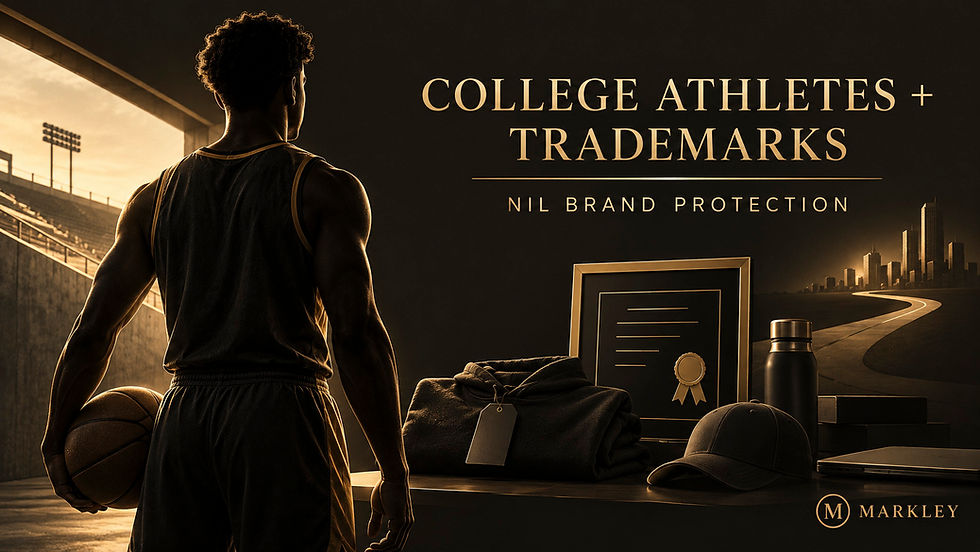
What's the Difference Between NIL Rights and a Trademark?
Think of it this way: publicity rights protect your persona; trademarks protect your product.
Your right of publicity arises automatically under state law. It stops a brand from putting your picture on a billboard without paying you. However, state laws vary wildly, and they don't give you a federal registration number.
A federal trademark requires a USPTO application. Once granted, it gives you a enforceable property right across all 50 states. If a competitor sells fake "PAIGE BUCKETS" shirts, state publicity laws make for a cumbersome lawsuit. A federal trademark registration lets you file a streamlined marketplace takedown in minutes.
What Can an Athlete Actually Register?
You aren't limited to your legal name. Depending on what you sell, you can register:
Your legal name or nickname: Nicknames (like "Honey Badger" or "Sauce") are often easier to register than common legal surnames, which face extra hurdles at the USPTO.
Logos and monograms: A custom visual mark or stylized signature.
Catchphrases: Registrable if consumers recognize it as your brand rather than a generic slang term (which gets rejected under the "failure to function" rule).
Venture names: The specific name of your podcast, apparel line, or foundation.
Note: Trademarks are tied to specific goods and services (called "classes"). You only get protection for the categories you actually register and pay for.
The Search Mistake That Kills Applications
When UConn star Paige Bueckers applied to register "PAIGE BUCKETS," the application was ultimately abandoned after facing opposition from a prior trademark owner.
This carries a critical lesson: Fame does not clear a trademark.
The USPTO does not care about your follower count or on-field stats; it only cares whether your proposed mark is confusingly similar to an existing registration. A proper clearance search before filing surfaces these conflicts while they are still cheap to fix—allowing you to tweak the design, narrow your product scope, or choose a different brand name entirely.
You also need to audit your school's IP. If your personal mark incorporates a team mascot, university color scheme, or campus catchphrase, expect an opposition from the university's legal team or a refusal from the USPTO examiner.
When Should an Athlete File?
Early — but not indiscriminately.
Run the clearance search first. Your name, your nickname, your catchphrase, and your school's marks. This is the step that prevents the Paige Buckets outcome, and it's cheap compared to a dead application.
File before the breakout, not after. Trademark squatters watch highlight clips. The moment a nickname trends on social media, third parties try to file it. Untangling a squatter’s application after the fact is expensive.
File in 2 to 4 classes that match real activity. Filing in every possible class multiplies government fees without adding meaningful protection for things you don't actually do. Apparel (Class 25) and entertainment or educational services (Class 41) are common starting points; add classes as the business genuinely expands.
Use intent-to-use if you're pre-launch. If you have a merch line planned for next season, an Intent-to-Use (ITU) filing locks in your priority date today while you build out the product line.
Keep the registration in your own name or your own entity. Your trademark is your private property, filed federally — it isn't subject to university approval. Your commercial activities under it still have to follow applicable NIL rules, school policies, and conference requirements, which is a separate compliance question worth asking about.
Document everything from day one. Dated evidence of use (sales, merch photos, ads, launch dates) is what proves priority if anyone challenges you later.
What Does It Cost, and Is It Worth It?
The USPTO's base filing fee is currently $350 per class. Two classes is $700 in government fees, before professional help. Surcharges apply for incomplete applications ($100 per class) and for writing your own goods descriptions instead of using the USPTO's pre-approved language ($200 per class) — which is how DIY filings quietly get expensive.
Is it worth it? Honest answer: it depends on whether you have a brand or just an income. An athlete doing a few local endorsement deals may not need a registration yet. An athlete selling merch, building a following, or planning a business that outlives their playing career almost certainly does — because that's a brand with a value that can be stolen.
And there's a timing asymmetry worth understanding. Your athletic window is short; your brand's window doesn't have to be. The athletes who build IP foundations while still in school are the ones with something to license, sell, or grow afterward.
FAQ
Do I need my school's permission to file a trademark?
No. A federal trademark application is filed with the USPTO and the registration is your own property. But your commercial activities under that brand still have to comply with NIL rules, state law, and school and conference policies.
Can I trademark my own name if it's common?
Possibly, though common surnames face extra hurdles — the USPTO scrutinizes marks that are primarily merely a surname. Distinctive nicknames often register more easily than legal names.
What if someone already filed on my nickname?
Move fast and get an attorney. Depending on the facts, you may have prior-use rights, grounds to oppose, or a path to a negotiated resolution — but the burden and the clock work against whoever waits.
Does a trademark stop people from selling merch with my name?
It's the most effective tool for it. A registration unlocks marketplace takedown processes and supports infringement claims in a way unregistered rights simply don't.
When exactly should I file?
Generally once your brand is settled and before it peaks. Filing during a breakout moment is better than after; filing before is better still.
Your name is the one asset that follows you out of the tunnel and into whatever comes next. Markley helps athletes protect it — flat-fee federal trademark filing by licensed California attorneys, a real clearance search first, and an honest answer about whether your mark will actually register before you spend a dollar filing it. Own your mark.


